ASRock Challenger RX 9050 8GB vs ASUS Dual RTX 3050 OC 6GB
The ASRock Challenger RX 9050 8GB uses the AMD RX 9050, 8 GB, while the ASUS Dual RTX 3050 OC 6GB uses the NVIDIA RTX 3050 (Ampere), 6 GB GDDR6 on a 96-bit bus, 70 W board power.
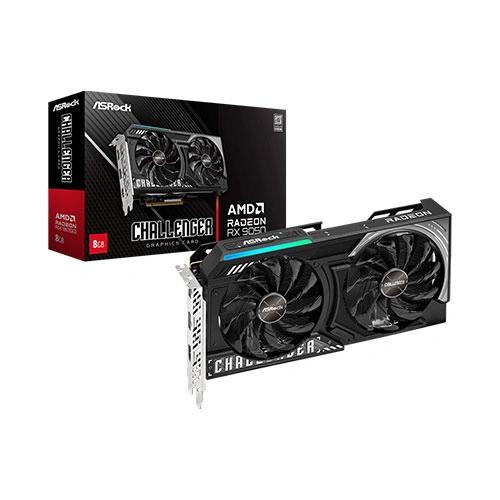
Final score
50 / 100
Lowest price
₹33,999
at Computech Store
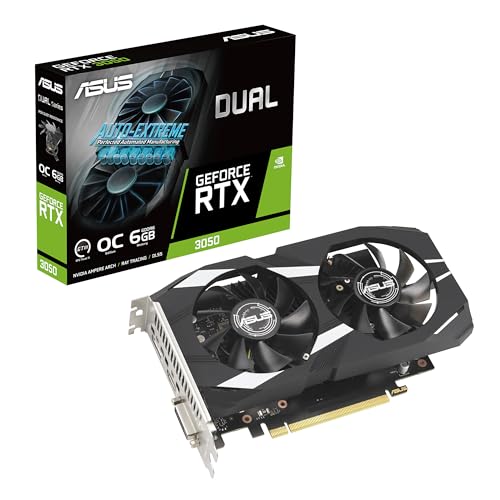
Final score
38 / 100
Lowest price
₹29,386
at MD Computers
Compare different graphics cards
Overview
Sub-scores from 0 to 100, relative to the best product in our database.
Scoring for: Balanced
Value for money
Balanced score points per ₹1,000, using today's lowest in-stock prices.
1.47
score points per ₹1,000
1.29
score points per ₹1,000
ASUS Dual RTX 3050 OC 6GB is ₹4,613 cheaper right now.
The verdict
ASRock Challenger RX 9050 8GB is the better graphics card overall, scoring 50 vs 38.
- It leads in vram (+33%).
- It's also the better value for money at current prices.
- ASUS Dual RTX 3050 OC 6GB uses a PCIe x8 link; on PCIe 3.0 motherboards it can lose some performance.
Pick ASRock Challenger RX 9050 8GB if…
- you game at 1080p or play esports titles (1080p Gaming score 50 vs 38)
- you play at high settings, use big texture packs or run AI models
Pick ASUS Dual RTX 3050 OC 6GB if…
- you want to save money (cheaper by ₹4,613)
Came for the spec sheet? We see you. Scroll on. ↓
Key differences
Only real differences in specs, scores and price. Ties are left out.
Advantages of ASRock Challenger RX 9050 8GB
- 33% more VRAM headroom
- 2 GB more VRAM (8 vs 6 GB)
Advantages of ASUS Dual RTX 3050 OC 6GB
- Cheaper by ₹4,613
Benchmarks
Chip-level results: cards using the same GPU perform within a few percent of each other. (est.) marks estimated values.
Gaming performance
Relative average FPS across a game suite (RTX 5090 = 100 at each resolution). Higher is better.
Ray tracing
Relative average FPS with ray tracing on at 1440p (RTX 5090 = 100). Higher is better.
3DMark Time Spy
DirectX 12 synthetic graphics score. Higher is better.
Blender (GPU render)
Blender Open Data median score with CUDA/OptiX, HIP or oneAPI. Higher is better.
Efficiency
Time Spy graphics score divided by rated board power. Higher is better.
Full specifications
The better value is highlighted. “—” means we don't have that spec yet.
| General | ASRock Challenger RX 9050 8GB | ASUS Dual RTX 3050 OC 6GB |
|---|---|---|
| GPU | RX 9050 | RTX 3050 |
| Architecture | — | NVIDIA Ampere |
| Release Date | — | Feb 2024 |
| Factory Overclocked | No | Yes |
| White Edition | No | No |
| GPU Core | ASRock Challenger RX 9050 8GB | ASUS Dual RTX 3050 OC 6GB |
|---|---|---|
| Shader Units | — | 2,304 |
| Base Clock | — | 1,042 MHz |
| Boost Clock | — | 1,470 MHz |
| L2 / Infinity Cache | — | 2 MB |
| Process Node | — | 8 nm |
| Memory | ASRock Challenger RX 9050 8GB | ASUS Dual RTX 3050 OC 6GB |
|---|---|---|
| VRAM | 8 GB ✓ | 6 GB |
| Memory Type | — | GDDR6 |
| Memory Bus | — | 96-bit |
| Memory Bandwidth | — | 168 GB/s |
| Power | ASRock Challenger RX 9050 8GB | ASUS Dual RTX 3050 OC 6GB |
|---|---|---|
| Board Power | — | 70 W |
| Recommended PSU | — | 300 W |
| Power Connector | — | none |
| Interface & Features | ASRock Challenger RX 9050 8GB | ASUS Dual RTX 3050 OC 6GB |
|---|---|---|
| PCIe Version | — | 4.0 |
| PCIe Lanes | — | x8 |
| Hardware Ray Tracing | — | 2nd gen |
| Upscaling | — | DLSS Super Resolution |
| Frame Generation | — | No |
| AV1 Encoding | — | No |
Related comparisons
- ASRock Challenger RX 9050 8GB vs Gigabyte Windforce V2 RTX 3050 OC 8GB
- ASRock Challenger RX 9050 8GB vs NVIDIA Quadro RTX A400 4GB
- ASRock Challenger RX 9050 8GB vs ASUS Dual RX 7600 OC 8GB
- ASUS Dual RTX 3050 OC 6GB vs NVIDIA Quadro RTX A400 4GB
- ASUS Dual RTX 3050 OC 6GB vs Gigabyte Gaming Arc A380 OC 6GB
- ASUS Dual RTX 3050 OC 6GB vs Gigabyte Windforce V2 RTX 3050 OC 8GB